
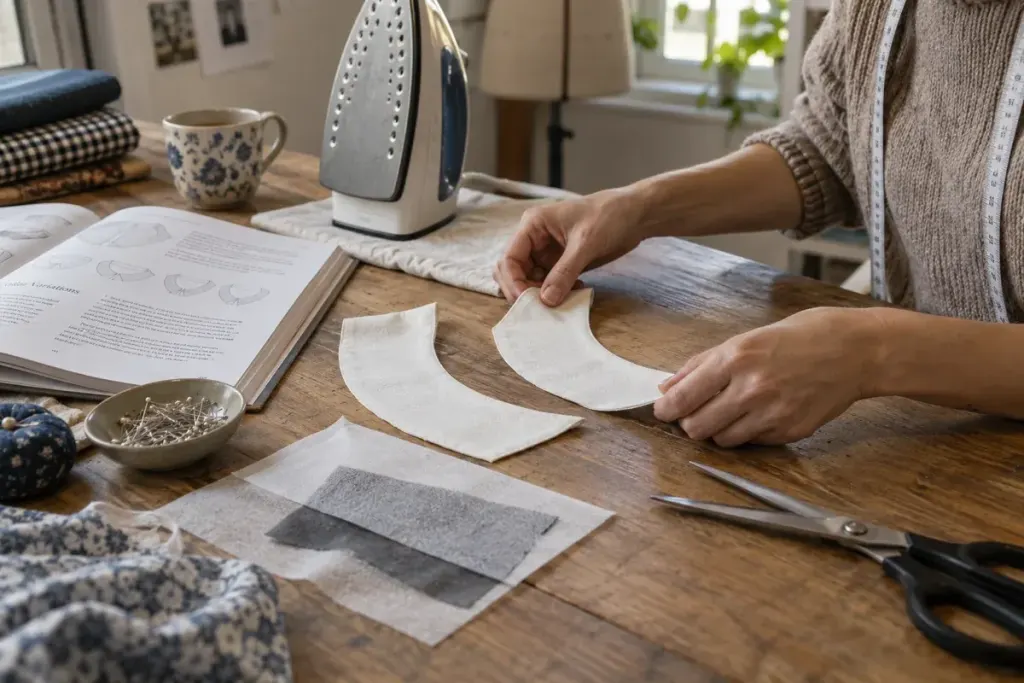
The collar looks crisp on the pattern envelope, but your finished sample feels like cardboard. Or the facing is soft and attractive until bubbles appear after washing. The hidden interfacing layer can change a garment as much as the fabric you chose for the outside.
The safest place to discover that difference is on an offcut. A small paired sample lets you compare supported and unsupported fabric before cutting or pressing an important piece.
Match the support to the job
A collar, a button band and a flowing neckline do not necessarily need the same stiffness. Consider whether the area must hold a shape, resist stretching or simply gain a little body. Start with the pattern’s recommendation and the interfacing manufacturer’s suitability guidance.
Vlieseline’s product and application guidance is a useful reminder that fusible materials have specific application requirements. Check the exact product instructions for temperature, moisture, pressing time and cooling. Instructions for one interfacing are not a universal setting for another.
Make a sample that answers a real question
Cut an offcut large enough to handle and fold, with the same grain direction and layers planned for the garment. Keep an untreated piece beside it. Mark which product you used and follow its pressing method on a protected surface.
Let the sample cool as directed before judging adhesion. Then bend it, hold it vertically and fold it into the approximate shape of the garment section. A flat square can look acceptable while a folded collar becomes unexpectedly bulky.
Include the care routine
If the finished garment will be washable, test a representative sample using care compatible with both fabric and interfacing. Check again after drying: has the surface changed, has the adhesive released, or does the supported area shrink differently?
For an illustrative comparison, try two suitable light interfacings rather than jumping from a very soft product to the heaviest one available. Label the samples before washing so the result remains useful. Do not attempt to force an unsuitable fusible onto a heat-sensitive fabric; consider an appropriate alternative construction.
Keep the successful sample with a short note about the fabric and application. That small library of actual combinations is more reliable than remembering that a packet described itself as “lightweight”. The right result is support that serves the garment, not stiffness for its own sake.