
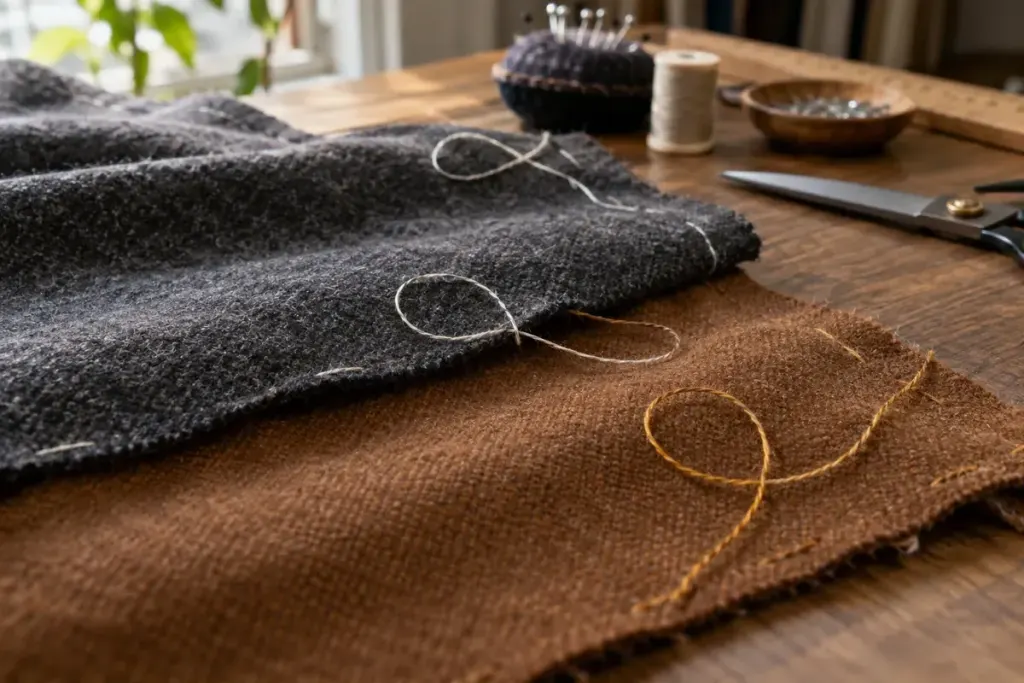
The edge of a pattern piece is easy to see after cutting. A pocket corner or dart point in the middle of the cloth is easier to lose. Tailor’s tacks leave a temporary thread mark at that internal position, including on both pieces when fabric has been cut in two layers.
The method is especially useful to consider when chalk is hard to see or a marking pen is unsuitable for the fabric. It still deserves a scrap test: choose a needle and thread that leave neither damage nor unwanted colour behind.
The looseness is deliberate
Felixstowe Sewing School’s tailor-tack demonstration shows a loose loop and tails passing through the marked position. The thread is not tightened like an ordinary securing stitch. That extra length allows the fabric layers to be separated and the connecting threads cut between them.
Keep the pattern aligned while placing the marks. Work through the intended layers, lift the paper carefully, and ease the fabric pieces apart only enough to see the threads between them. Snip those threads without catching the cloth. Each layer should retain its own visible mark.
If one side ends up blank, stop before the original pattern position is lost. Reposition the paper accurately and replace that mark. Guessing from the mark on the other piece can introduce an error that later looks like a cutting problem.
Give every mark a meaning
A thread tuft identifies a location; it does not explain whether that location is a dart tip, pocket corner or pleat reference. Keep the pattern instructions nearby and transfer enough of the required information to recognise the feature.
As a practice exercise, mark three imaginary pocket corners on two scraps, separate them, and check whether you can reconstruct the intended shape on each scrap independently. This tests the whole transfer process before you work on a garment front.
Handle the marked pieces gently because loose threads can pull out. Remove tacks once the relevant position has been securely established in the construction, and check both sides for remnants. Their job is to guide the sewing, then disappear without leaving another mark to explain.