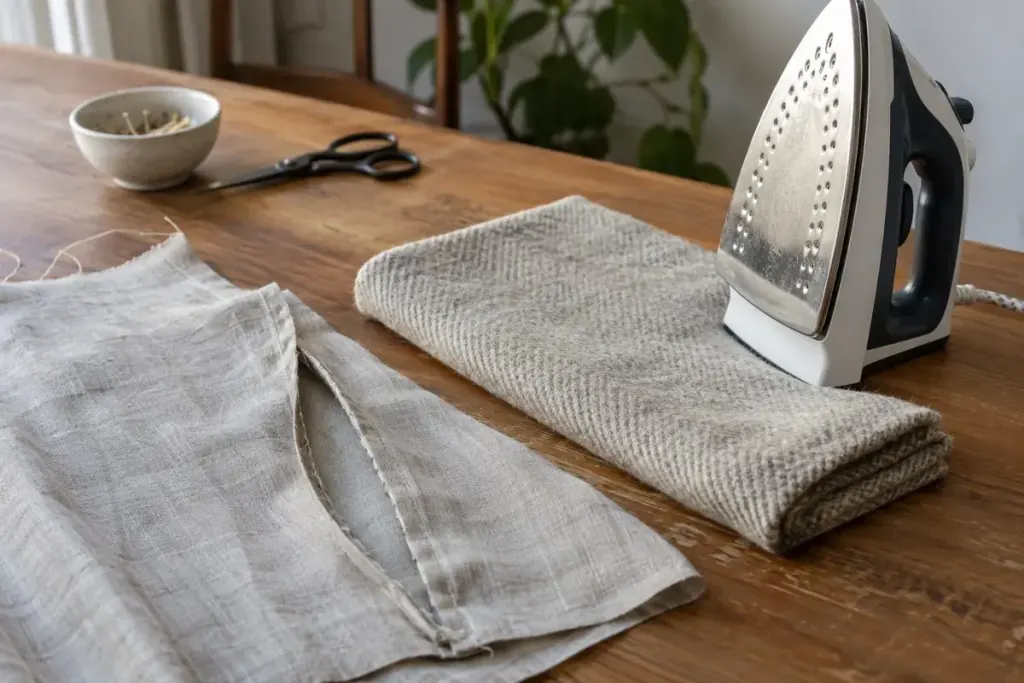
A seam can be neatly stitched and still look unfinished because its allowances bunch together. Pressing gives those layers a deliberate position. The aim is not to flatten every fabric as hard as possible; it is to shape the seam without distorting the material around it.
Make the test match the garment
Stitch a small sample using the actual fabric, thread and seam allowance. Check the fabric’s care information and start with an appropriate conservative heat setting. Some fibres, finishes and interfacings are sensitive to heat, moisture or pressure. An inconspicuous test is more useful than assuming every fabric of a similar colour behaves alike.
Try a clean pressing cloth when suitable for the material, and inspect both sides after the sample cools. Look for shine, colour changes, flattened texture, puckering or the outline of the allowance showing through. Stop if the finish changes; more pressure is unlikely to correct heat damage.
Lift, place and release
Pressing differs from pushing the iron repeatedly across a shirt. Lift and place it deliberately, using the support and technique appropriate to the seam. Sliding across a curved or bias-cut area can stretch it. Let the section settle before moving it again.
Open the allowances only when the construction calls for that finish. Some seams are pressed together, and some need their allowances graded or otherwise prepared first. Follow the pattern’s sequence so you do not press a fold that the next step asks you to undo.
Support the shape you want to keep
A flat board suits a straight sample, while a curved garment section may need a suitable pressing form. Avoid crushing a three-dimensional shape against a flat surface merely because that surface is convenient. Keep fingers clear of steam and place the iron safely between uses.
Inspect the result under ordinary side lighting after it cools. If the seam lies comfortably and the surrounding texture looks unchanged, the job is done. Record the successful setting on the project notes; the next seam should benefit from the test rather than become another experiment.