
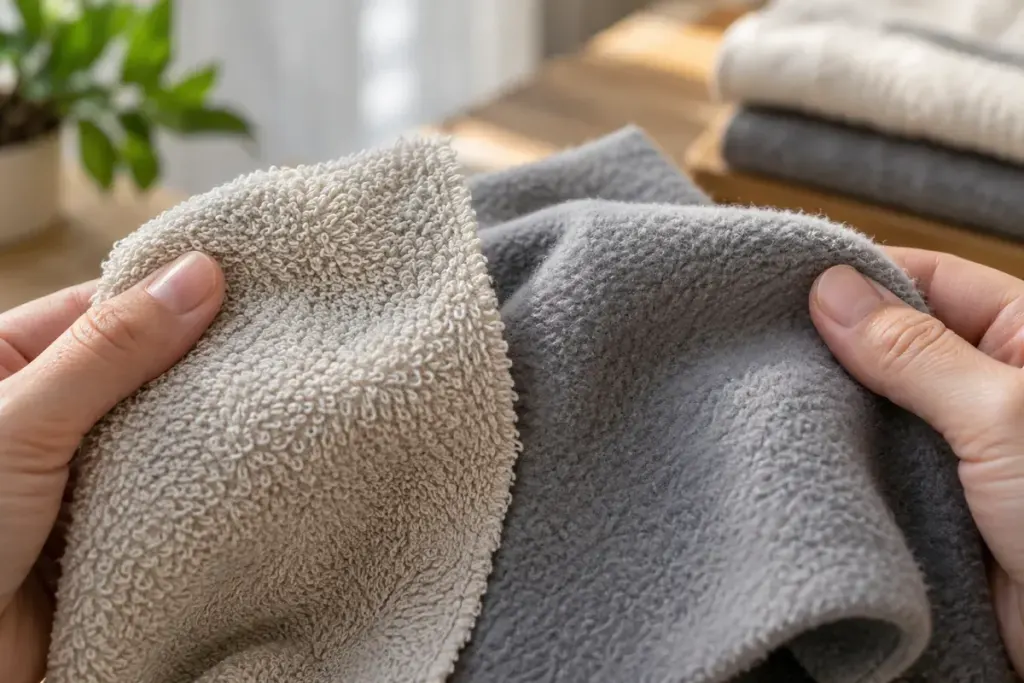
Two sweatshirt fabrics can look almost identical from the outside. Turn them over and one shows small loops while the other feels soft and fuzzy. That reverse surface is worth examining before choosing material for a garment.
French terry commonly has loops on its reverse. Sweatshirt fleece has a brushed reverse that raises fibres into a soft surface. Retail names vary, so ask for a sample and the supplier’s construction details rather than relying on the word “sweatshirt” alone.
Compare the whole swatch
Fold each sample into a small double layer and feel its thickness. Stretch it gently in both directions and observe its recovery without pulling it out of shape. Check the listed fibre composition, weight and care instructions separately: a looped or brushed surface does not tell you all of those things.
For an invented sewing choice, a loose indoor top may suit a lighter looped fabric, while someone wanting a more substantial feel may prefer a particular fleece sample. That is a comfort and construction choice, not proof that every fleece is warmer than every French terry. Weight, fit and layers also matter.
Think about the seams as well as the face
A bulky reverse can change the feel of a folded cuff or waistband. Stack the number of layers your pattern will require and compare the thickness before cutting. Test the seam with the intended needle and stitch on an offcut, following the machine and fabric guidance.
If you plan to show the reverse at a rolled sleeve, inspect its appearance deliberately. A surface that feels pleasant inside a garment may not create the visual finish you expected outside it. Check whether the sample sheds loose fibres during ordinary handling and washing.
Keep the sample’s identity
Attach the supplier, colour, composition and care information to each swatch. Wash a sample as directed before deciding how the fabric behaves; do not compare one washed piece with another straight from the roll without noting that difference.
The reverse side is not hidden information once you know to look. It can explain why two similar-looking fabrics produce quite different everyday garments.