
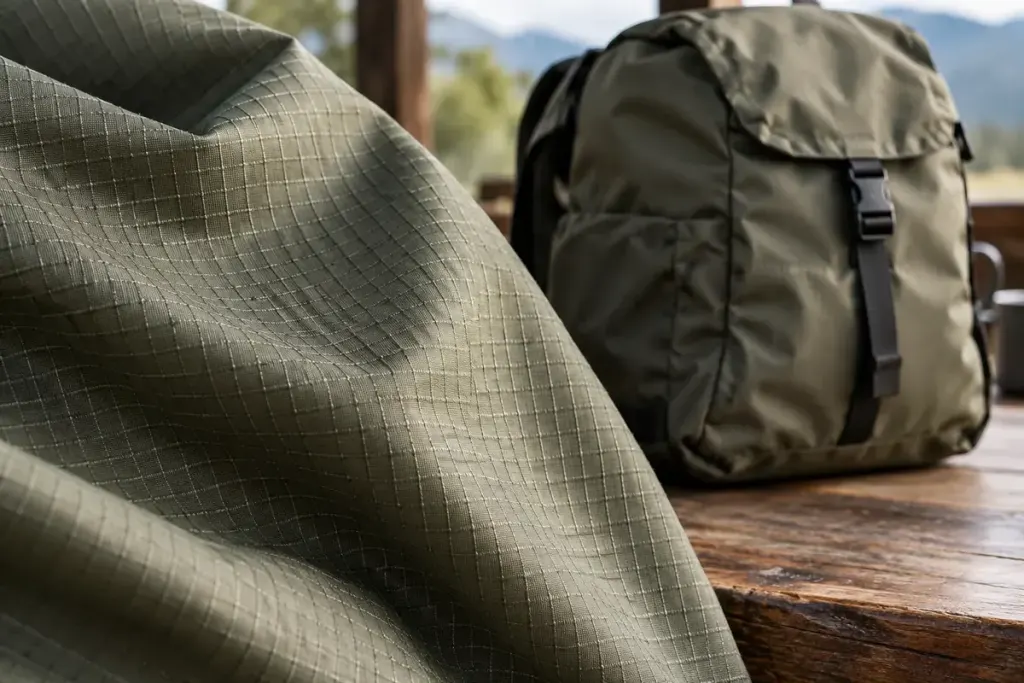
The fabric has a neat square grid, so it looks ready for an outdoor project. That visible structure gives you information about the weave. It does not, by itself, tell you how the finished material will behave in rain.
Keep construction and finish in separate columns when reading a specification. Ripstop describes a reinforced woven structure. Water performance depends on the particular material, treatment or coating and, in a finished item, the way seams and openings are made.
The manufacturer’s CORDURA Classic information, for example, distinguishes finished, coated and laminated options within a fabric family. It is a useful reminder to read the exact product specification instead of transferring one fabric’s properties to every cloth with a similar appearance.
Ask for the claim that matches the use
Is the supplier describing water repellency, resistance to a particular test, or a waterproof construction? What test and conditions support that description? A bag used for a brief commute has a different exposure from a cover left outdoors for long periods.
Check which face carries a coating and what sewing, cleaning and storage guidance applies. Heat, adhesives or an unsuitable cleaning method may affect a finish. A visual inspection cannot establish all those limits.
Think beyond the flat sample
Needle holes, zip openings and joins can become the relevant weak points even when the cloth itself meets a useful specification. Ask how the planned construction handles them before cutting the expensive material.
A small home sample can help you understand handling and appearance, but it is not a certified performance test. Avoid treating a few droplets on a swatch as proof that the completed project will keep important equipment dry.
Keep the product code and care information with your pattern notes. The next fabric with the same grid may be a different weight, finish or fibre, and deserves its own check.