
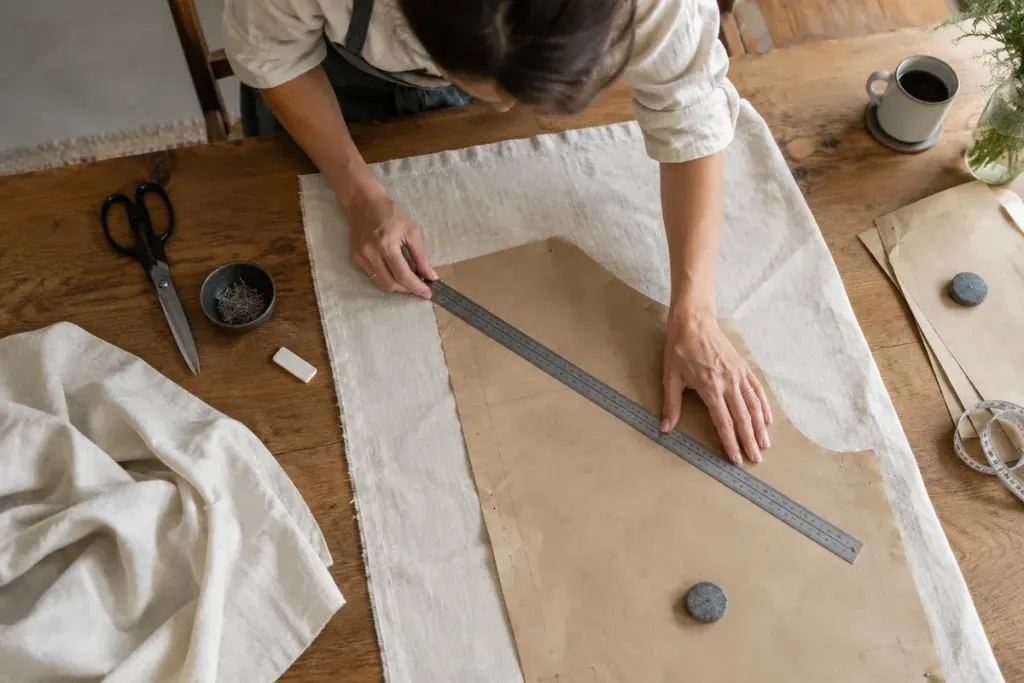
You cut carefully and sewed a neat seam, yet the side of the garment keeps turning towards the front. The problem may have begun before the first stitch: the pattern was placed at an angle to the fabric’s grain.
In woven cloth, the lengthwise and crosswise threads create a structure. The pattern’s grainline tells you how its pieces should relate to that structure. A printed stripe or a cut edge can look straight without being a dependable guide to the underlying weave.
Identify the reference edge
The selvage is the finished lengthwise edge of the cloth. Seamwork’s explanation of grainlines describes how aligning pattern pieces with the grain helps a garment hang as intended. For a standard straight-grain layout, the pattern arrow is generally positioned parallel to the selvage.
First read the pattern’s actual instructions. Pieces cut on a fold, bias-cut designs, knits and fabrics with a directional surface may need different handling. Grainline is one instruction among several; it does not replace the cutting layout, stretch requirements or nap direction.
Measure both ends of the arrow
Lay the cloth flat without stretching it into position. Place the pattern, then measure from each end of its grainline arrow to the same selvage. Equal distances show that the arrow is parallel. Secure the piece and check again before cutting, because pinning or moving another piece can shift it.
For a long piece, checking only one point leaves plenty of room for rotation. Use a ruler suited to the distance and keep the measuring direction consistent. If the table is too small, support the remaining fabric so its weight does not pull the layout out of position.
Do not let a pretty print overrule the structure
A motif may be printed slightly off-grain. Matching the picture perfectly can then conflict with the way the cloth needs to hang. Notice the conflict before you cut expensive fabric. A test piece or a different layout may be more sensible than trying to force both objectives into alignment.
Likewise, a shop-cut edge may be uneven. Squaring the cloth should be done with a method appropriate to the weave and finish, not by stretching it until the edges look tidy. Ask the supplier or a knowledgeable sewing tutor if the cloth appears badly distorted.
A small practice piece is cheaper than a twisted garment
Use an offcut to compare how the fabric behaves along the length, across the width and diagonally. This is an observation exercise, not a substitute for the pattern’s specification. Label the directions so you can relate what you feel to the cutting instructions.
Once the layout is settled, photograph it before cutting. A record of the selvage and arrow positions makes later troubleshooting much more useful than a general memory that everything looked straight.