
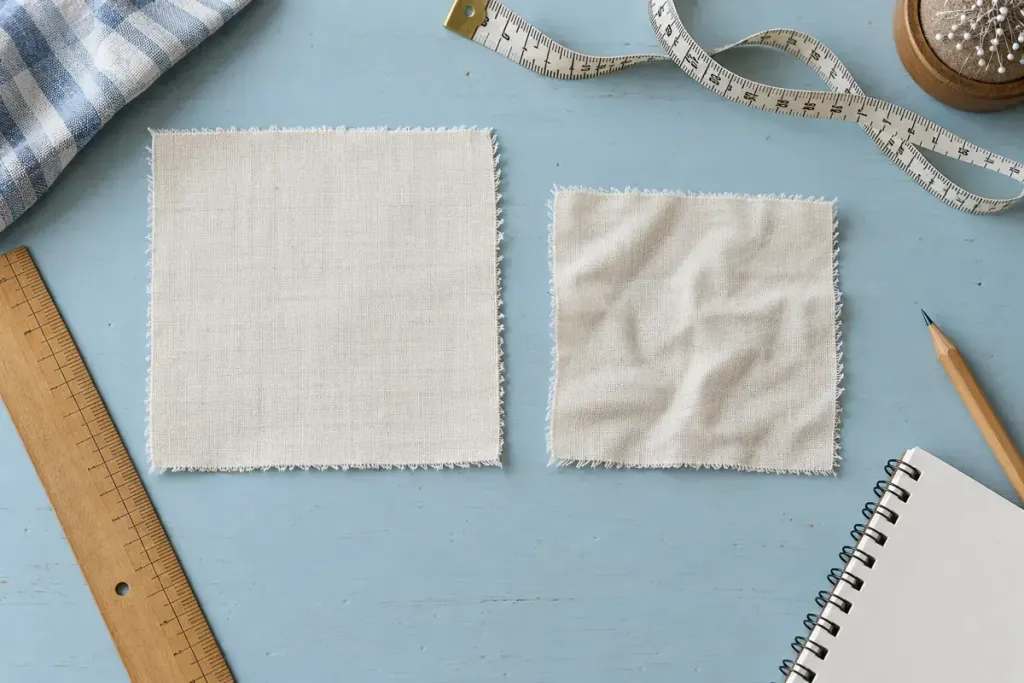
Pre-washing can feel like an extra chore until a finished sleeve becomes shorter than planned. A measured sample gives you information while the project is still easy to change.
Follow the care instructions for the exact fabric. Spoonflower’s apparel-fabric guidance illustrates why care and estimated shrinkage vary between materials and recommends pre-washing for many projects. That does not mean every fabric should go through the same cycle.
Keep an unwashed reference
When you have enough material, retain one labelled sample and test another. Label the directions so you can distinguish lengthwise from crosswise measurements. Photograph the sample beside a ruler if useful, but keep written figures as the main record.
Mark a measurable area within the sample using a method that will not damage the fabric. Measure carefully on a flat surface without stretching. Frayed edges are unreliable measuring points, so use consistent internal reference marks where suitable.
Repeat the care process the finished item will receive
Use a process allowed by the manufacturer and appropriate to the intended item. Note the wash setting, drying method and any pressing. Do not compare a tumble-dried test with a finished garment you intend to dry flat and assume they are equivalent.
Wait until the sample is fully dry and settled before measuring again. Treat special-care fabrics according to their instructions, and ask the supplier when the care label is unclear.
Calculate each direction separately
For an illustrative sample, suppose a marked length changes from 20 cm to 19.4 cm. The reduction is 0.6 cm. Divide 0.6 by 20 and multiply by 100: the observed shrinkage is 3%. Calculate width separately; do not assume it changed by the same percentage.
One small home test is not a guarantee for an entire roll. Its value is that it replaces a guess with a documented observation of your sample under your chosen care conditions.
Look beyond the ruler
- Did the surface become softer, rougher or more wrinkled?
- Did the print or colour change visibly against the unwashed reference?
- Did the sample twist or lose its original shape?
- Does its new drape still suit the project?
If the result is unsuitable, change the project or fabric before cutting the final pieces. If it is suitable, prepare the yardage consistently and keep the test note with the pattern. Record the supplier’s fabric reference so a later purchase is not confused with a similar-looking cloth.
For the first stage of choosing material, use the four-observation swatch check. The two exercises work together: one considers the cloth’s job, the other tests its likely care routine.