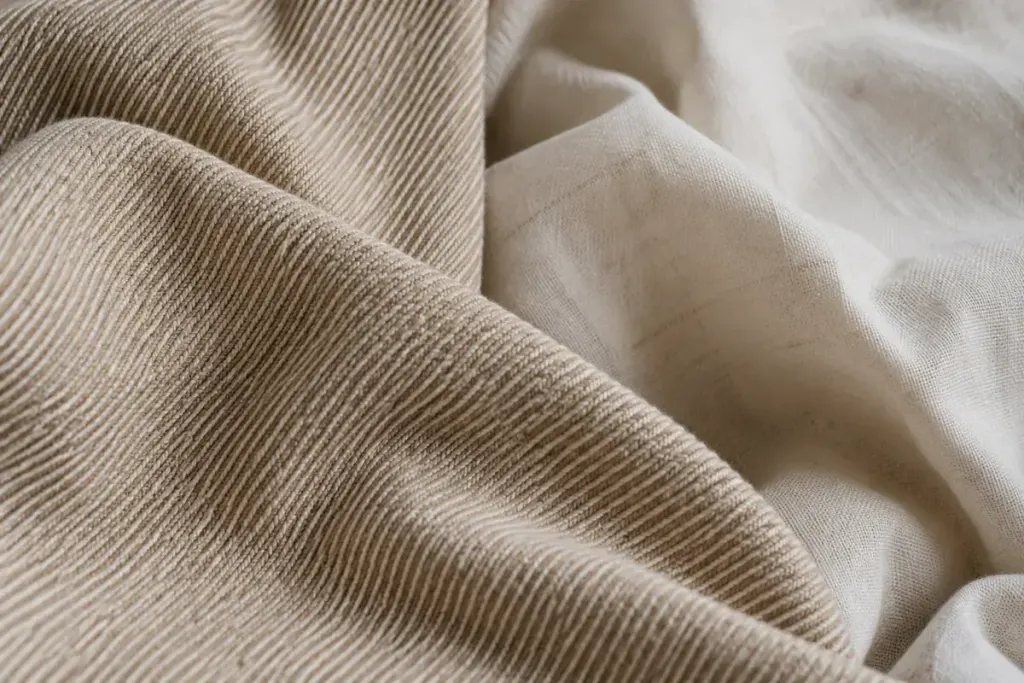
Two cotton fabrics may share a fibre label and still behave differently on the cutting table. One has a simple checked interlacing; the other shows a diagonal line. That diagonal can be a clue to twill construction.
CottonWorks’ guide to woven structures describes twill by its diagonal pattern. Unlike a plain weave’s regular over-one, under-one interlacing, a twill repeat offsets the interlacing across successive yarns, producing the characteristic line.
Look closely before naming the cloth
Lay a small sample under good light and turn it slowly. Compare both faces with a magnifier if available. Is the diagonal part of the woven structure, or is it only a printed stripe? A surface design can resemble a weave without being made by that weave.
Labels such as 2/1 and 2/2 refer to interlacing patterns. They are not fibre percentages or washing temperatures. A twill may be made from different fibres, yarn weights and finishes, so the name alone cannot tell you whether it will make a soft shirt or a firm work trouser.
Build a sample note that helps a project
For an illustrative comparison, place a plain cotton swatch and a cotton twill swatch of similar weight beside each other. Fold each over the same ruler, then let it hang from the same point. Record the visible structure and the observed drape separately. This avoids crediting every difference to the weave when the yarn or finishing treatment may also differ.
Keep the seller’s fibre composition, weight and care information with the sample. If the fabric is intended for a garment, test its preparation and seam behaviour using the product’s instructions before cutting the final pieces.
The useful conclusion is specific: this sample has a visible diagonal and behaves this way in this test. “Twill” helps you ask the next question; it does not replace handling the actual cloth.