A woven fabric can look like one continuous surface until you examine a cut edge. Then its construction becomes clearer: one set of yarns crosses another. Learning those two directions makes specifications and sewing instructions easier to interpret.
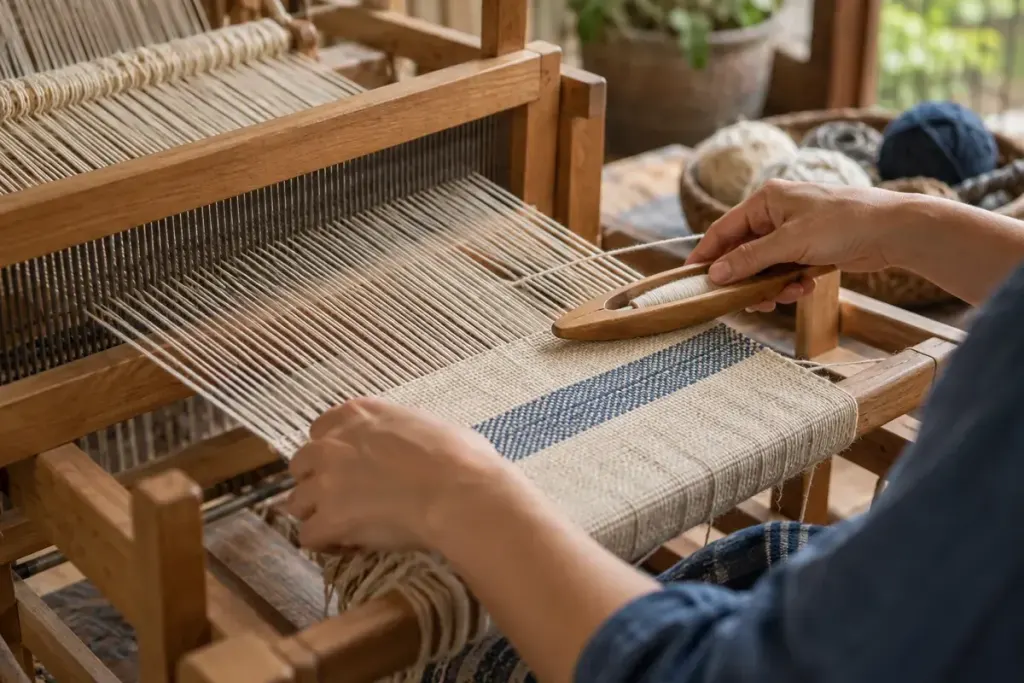
CottonWorks’ weaving guide describes warp yarns travelling through the loom and filling, also called weft, being inserted across them. Warp runs along the fabric length; weft runs across its width. These names describe the yarns’ role in construction, not their colour or fibre.
Start with a sample that has an edge
Use a spare piece of plain woven cloth, ideally with its selvedge still attached. Follow a yarn parallel to that finished edge, then a yarn crossing towards it. A magnifier and light from the side can make the interlacing easier to see. Do not pull threads from a garment you want to keep intact.
A striped design is not enough to establish direction: stripes can be printed rather than woven, and woven stripes can run in either direction. Likewise, the visually dominant yarn is not automatically the warp.
Separate construction from material
“Cotton” names a fibre. “Plain weave” describes a structure. “Warp” and “weft” name the yarn directions within that structure. A useful sample label can record all three without treating them as alternatives.
For example, an illustrative swatch card might say: cotton, plain woven, selvedge on the marked side. A separate observation could note that the fabric gives slightly more in one direction. That observation belongs to this sample; it is not proof that every woven cotton behaves identically.
Knitted fabric is built from intermeshing loops rather than the same two crossing sets. Knitting terminology can also include warp and weft, so use the construction context instead of assuming that seeing those words alone proves a fabric is woven.
When cutting for a project, follow the pattern’s grain instructions. Recognising warp and weft helps you understand those instructions, but it does not replace tests for shrinkage, stretch, drape or suitability. The practical gain is a clearer description of the cloth in front of you.