
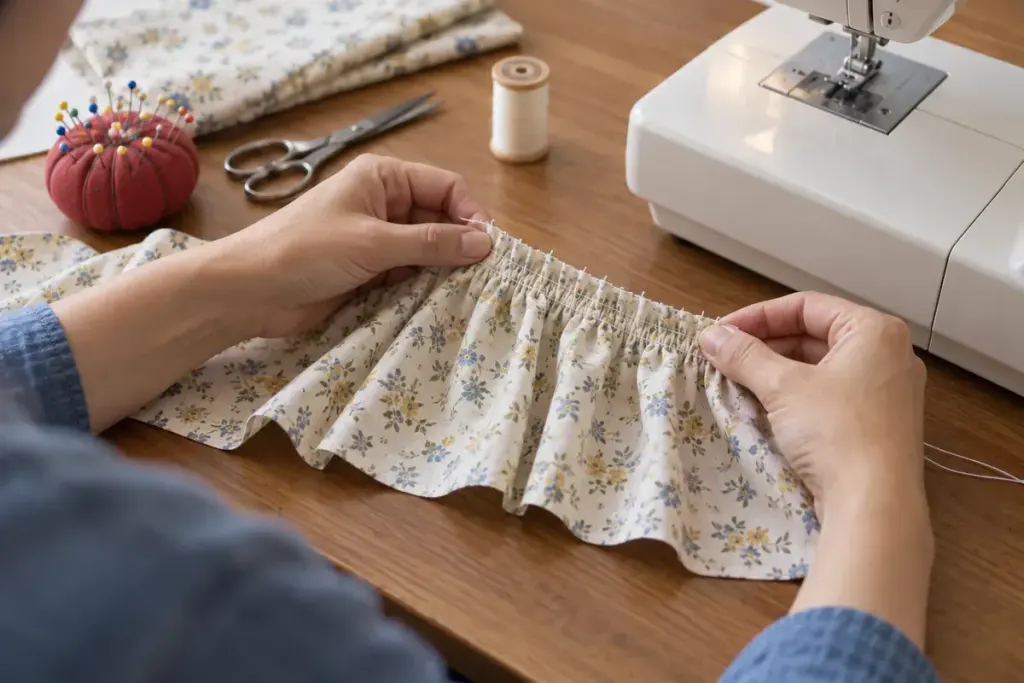
A ruffle can look evenly gathered on the table and bunch up as soon as it reaches the sewing machine. Two rows of temporary gathering stitches give the folds a little more guidance than a single row, especially when the gathered section must match a fixed-length edge.
The gathering instructions in Brother’s sewing-machine manual use parallel stitching and pulled bobbin threads. The manual’s settings belong to that machine and operation; test your own fabric and machine rather than treating one stitch length as universal.
Mark matching points before making folds
On a practice strip, mark the centre and quarter points of both the ruffle and its receiving edge. These marks divide the job into manageable sections. Without them, it is easy to use most of the fullness near one end and discover a flat patch at the other.
Sew two parallel rows within the placement allowed by your pattern, leaving thread tails. Avoid securing those temporary rows with backstitching where you need to draw the threads. Pull the bobbin tails gently from one end, moving the fabric along them rather than trying to force a large bunch through at once.
Match the marked points, distribute the small folds between them, and pin or baste as appropriate. Check that the folds run into the seam instead of folding sideways beneath it. Permanent stitching should follow the pattern’s seam allowance; remove visible temporary stitching afterwards without cutting the finished seam.
If a gathering thread breaks, stop and work on the affected section rather than pulling harder on the remaining tail. A scrap trial can reveal whether the fabric gathers smoothly or needs another method. Keep that trial with a note of the fabric, needle, and stitch setting for the next project.